Introduction
In the realm of computer graphics, the quest for realism and visual fidelity has driven the development of various rendering techniques. From the early days of rasterization to the advent of ray tracing, each method has contributed to the evolution of how we create and experience digital imagery. Ray Marching, a technique that emerged as an alternative to traditional ray tracing, offers unique advantages in rendering complex scenes with intricate details and dynamic effects.
With advancements in rendering techniques and algorithms, methods such as Ray Tracing and Path Tracing have emerged to accurately simulate the behavior of light, textures [NVIDIA], and materials in three-dimensional environments. These methods are widely used in still images and animations, though they require significant computational power. Additionally, technologies like shaders1, which allow customization at the pixel level, have become essential in gaming and simulation environments, delivering increasingly immersive visual experiences to users.
In this context, Ray Marching stands out as an innovative technique, particularly for real-time rendering of complex surfaces and fractals. Unlike traditional Ray Tracing, Ray Marching uses an iterative approach to detect surfaces within a Signed Distance Field (SDF) [Quilez, 2013]. An SDF is a function that returns the shortest distance from any point in space to the closest surface, which allows it to describe smooth and detailed shapes without needing traditional polygonal geometry. This technique is especially useful for rendering scenes involving implicit geometry, such as fractals and abstract scenarios, and is frequently applied in virtual reality environments and visual effects for games.
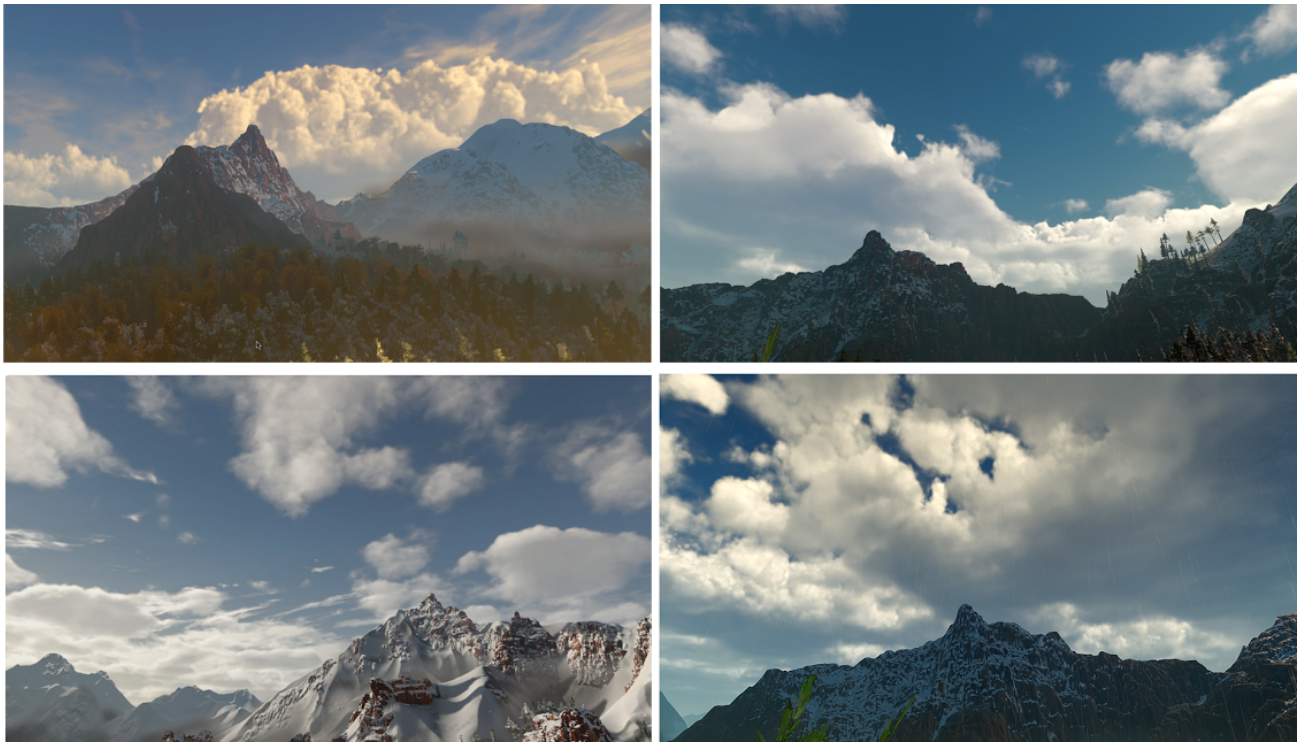
Ray Marching has found several practical applications in the gaming industry, particularly for rendering complex and dynamic scenes. In the Frostbite Engine [Hillaire, 2016], used in titles such as Battlefield V, Ray Marching is employed to render highly realistic volumetric clouds, as shown in Figure 1. This approach allows the engine to simulate depth, light scattering, and other atmospheric effects in real time, creating lifelike skies that respond dynamically to environmental lighting conditions.
Scope and Objective
During the following chapters, we will explore Ray Marching as implemented in GLSL and compare its strengths to traditional Ray Tracing methods. Our primary objective is to demonstrate Ray Marching's unique capabilities, particularly its use of SDFs, which allow for precise control over shapes and blending effects that are challenging to achieve with Ray Tracing.
We also explore the potential of Ray Marching for procedural rendering, showcasing its use in creating complex geometry with noise patterns and highly realistic volumetric effects, including cloud rendering. By examining these features, we aim to highlight Ray Marching's versatility and its advantages in generating intricate, dynamic visuals for real-time applications.
This work is intended for readers with a basic understanding of computer graphics and rendering techniques, though it is also accessible to those new to the field. The simplicity of ray marching's implementation allows us to implement it in a single fragment shader, making it an ideal subject for exploration and experimentation in the context of real-time rendering. This approach allows us to bypass the complexity and overhead associated with traditional graphics APIs and GPU programming, enabling us to focus on the core mathematical concepts, rather than the intricacies of graphics APIs.
Methodology
We take an iterative approach to explore the Ray Marching algorithm, showcasing its capacity to render smooth, noisy, and dynamic surfaces. Real-time 3D applications often rely on graphics APIs such as OpenGL, DirectX, or Vulkan for GPU programming. To simplify development and focus on Ray Marching itself, we use Shadertoy3, a tool for running fragment shaders written in GLSL (OpenGL Shading Language) without the extensive setup. All rendered scenes presented in this work are implemented as individual Shadertoy shaders.
- ↑ https://www.khronos.org/opengl/wiki/shader
- ↑ Source: media.contentapi.ea.com/content/dam/eacom/frostbite/files/s2016-pbs-frostbite-sky-clouds-new.pdf
- ↑ www.shadertoy.com